
The 4 MBTI dimensions explained
How the four letters work
The model goes back to Carl Jung's theory of psychological types, later developed by Katharine Cook Briggs and Isabel Briggs Myers. It describes preferences, not abilities. Just as you can write with both hands but prefer one, you use both sides of every pair — you simply reach for one more naturally.
Each pair is a spectrum. That is why our free test shows a percentage for every letter: someone who is 51% Introverted behaves quite differently from someone who is 90% Introverted.
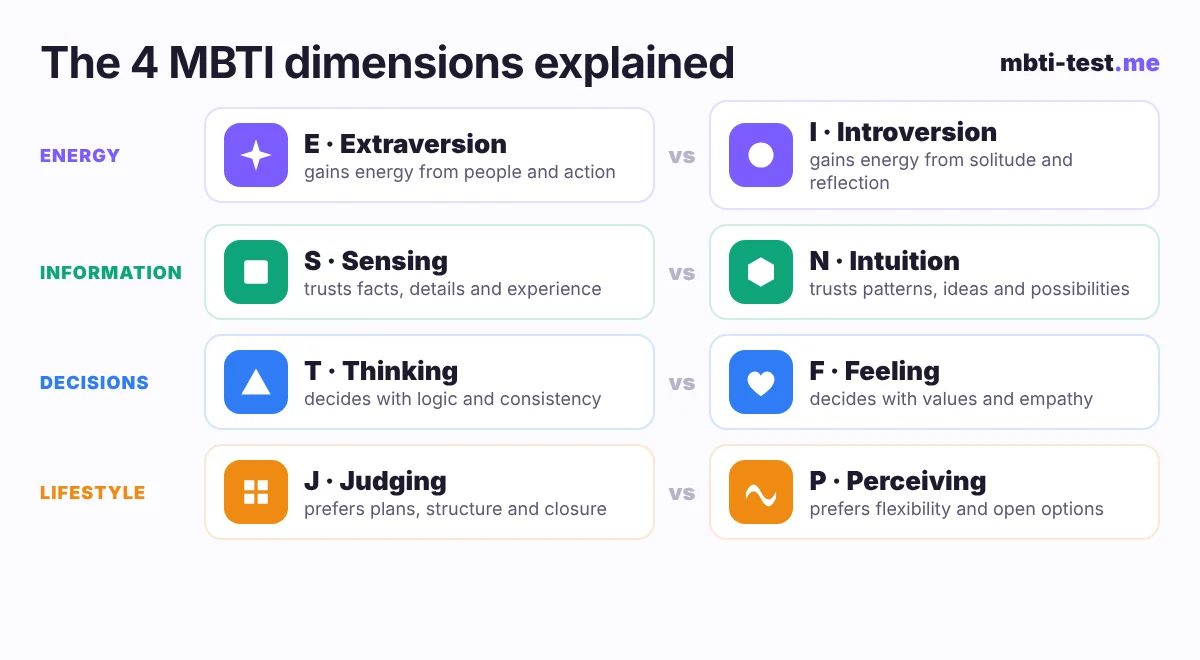
Extraversion (E) vs Introversion (I): where you get energy
Extraverts are energized by people, activity and the outside world. They often think out loud, enjoy variety and get restless when alone for too long.
Introverts are energized by quiet reflection and their inner world. They prefer depth over breadth in relationships, think before speaking and need time alone to recharge.
Introversion is not shyness. Many introverts are confident speakers; they just pay an energy cost for social time. Examples: ENFP and ESTJ are extraverted types; INFJ and ISTP are introverted.
Sensing (S) vs Intuition (N): how you take in information
Sensing types focus on concrete facts, details and real experience. They trust what they can see and test, and they tend to be practical and present-focused.
Intuitive types focus on patterns, meanings and possibilities. They read between the lines, enjoy theory and are naturally drawn to the future.
This pair often has the biggest impact on communication: S types like examples and steps, N types like concepts and the big picture. Around two-thirds of people prefer Sensing.
Thinking (T) vs Feeling (F): how you make decisions
Thinking types decide using logic, consistency and cause-and-effect. They value fairness as "the same rule for everyone" and can step back from a situation to analyze it.
Feeling types decide using values, empathy and the impact on people. They value fairness as "what is right for this person" and naturally consider harmony.
Thinkers have emotions and Feelers can be logical — the pair only describes which criteria come first when a decision is hard.
Judging (J) vs Perceiving (P): how you deal with the outside world
Judging types like structure, plans and closure. They prefer to decide early, make lists and finish work before playing. "Judging" does not mean judgmental.
Perceiving types like flexibility, spontaneity and keeping options open. They adapt quickly, enjoy starting things and often work in bursts close to a deadline.
In the cognitive-function model, this letter also tells you which of your functions you show to the outside world. Learn more in our cognitive functions guide.
How the letters combine into 16 types
Four pairs with two options each give 2 × 2 × 2 × 2 = 16 types. Types that share the middle two letters often form a temperament:
- NT – Rationals: INTJ, INTP, ENTJ, ENTP
- NF – Idealists: INFJ, INFP, ENFJ, ENFP
- SJ – Guardians: ISTJ, ISFJ, ESTJ, ESFJ
- SP – Artisans: ISTP, ISFP, ESTP, ESFP
Browse all of them on the 16 personality types page.
Frequently asked questions
What do J and P mean in MBTI?
J stands for Judging and P for Perceiving. J types prefer plans and closure; P types prefer flexibility and keeping options open. Neither is better.
Is it possible to be 50/50 on a letter?
Yes. Many people are close to the middle on at least one pair. In that case read both type descriptions and notice which feels more like you in everyday life.
Is introversion the same as being shy?
No. Introversion is about where you get energy. Shyness is anxiety in social situations. An introvert can be socially confident, and an extravert can be shy.