
The 8 cognitive functions explained
What are cognitive functions?
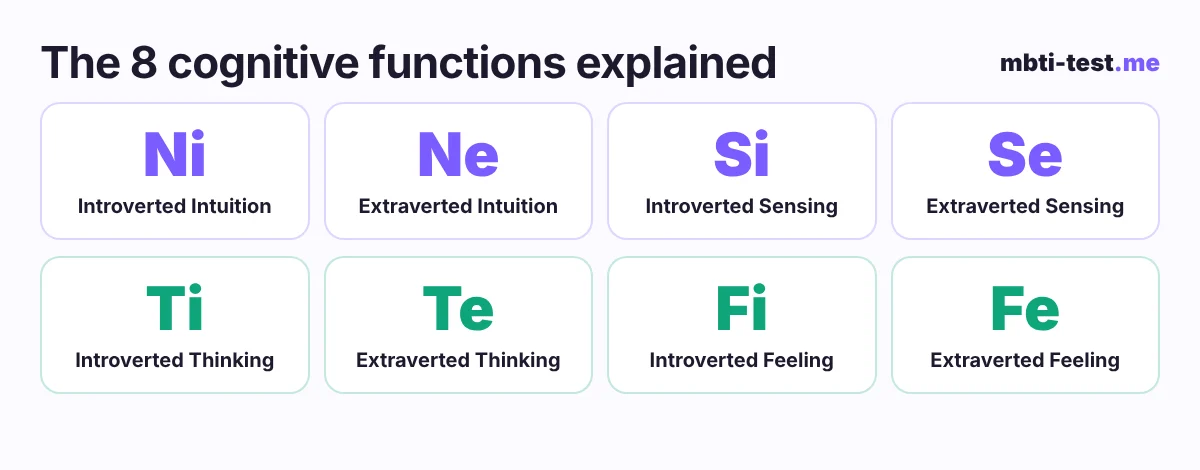
Jung described two ways of taking in information — Sensing and Intuition — and two ways of making decisions — Thinking and Feeling. Each can be directed outward (extraverted, "e") or inward (introverted, "i"), giving eight functions.
Your four letters are a shortcut to your functions. For example, INFJ uses Ni → Fe → Ti → Se, while INFP uses Fi → Ne → Si → Te. That is why two types that differ by only one letter can feel very different.
Introverted Intuition (Ni) – the visionary
Ni works in the background, combining impressions into a single insight about what something really means or where it is heading. People who lead with Ni often have "aha" moments and a strong sense of the future.
Extraverted Intuition (Ne) – the explorer of possibilities
Ne jumps from idea to idea, seeing connections and alternatives everywhere. It loves brainstorming, "what if" questions and new experiences.
Introverted Sensing (Si) – the keeper of experience
Si compares the present with a rich inner library of past experiences, details and body sensations. It values routine, reliability and proven methods, and it remembers how things are "supposed" to be.
Extraverted Sensing (Se) – the in-the-moment experiencer
Se is fully present in the physical world. It notices colors, movements and opportunities, reacts quickly and enjoys action, sports, style and sensory pleasure.
Introverted Thinking (Ti) – the inner logician
Ti builds a precise internal framework to understand how things work. It values accuracy, clear definitions and consistency, and it enjoys taking ideas or machines apart.
Extraverted Thinking (Te) – the organizer
Te organizes the outside world. It sets goals, uses data, measures results and makes systems efficient. It is direct and decisive.
Introverted Feeling (Fi) – the inner compass
Fi evaluates everything against a deep set of personal values. It seeks authenticity, identity and being true to oneself, and it feels emotions intensely but privately.
Extraverted Feeling (Fe) – the harmonizer
Fe tunes in to the emotions and needs of the group. It reads social cues, adapts to others and works to create harmony, connection and shared values.
How the function stack works
- Dominant (1st)
- Your strongest, most natural function. It develops early and defines the core of your type.
- Auxiliary (2nd)
- Supports the dominant function and balances it: if the dominant is a perceiving function, the auxiliary is a judging one, and vice versa.
- Tertiary (3rd)
- Develops later in life. It can be a source of fun and growth, or a trap when it teams up with the dominant to avoid the auxiliary.
- Inferior (4th)
- Your least developed function. Under heavy stress you may "fall into" it and act unlike yourself — every type profile describes this in its stress section.
Function stacks of all 16 types
Frequently asked questions
How do I find my cognitive functions?
Take the free MBTI test to get your four letters, then look up your type in the table on this page or on your type profile.
Are cognitive functions scientific?
Cognitive functions are a theoretical model from Jung and later type theorists. They are useful for self-reflection, but they have less research support than the four MBTI preference scales or the Big Five.
What is a loop in cognitive functions?
A "loop" is a popular term for when the dominant and tertiary functions work together and skip the auxiliary, for example an INFJ using Ni and Ti while ignoring Fe. It usually happens under stress.