

Rationals · NT
INTJ: The Strategist
Independent, visionary planner who turns big ideas into long-term strategies.
Who is the INTJ?
The INTJ is the quiet planner in the room who has already thought about what happens next year. They like to understand how systems work, spot what is inefficient and design something better. Small talk rarely interests them, but a conversation about ideas, science or the future can keep them going for hours.
INTJs are often described as private and self-sufficient. They trust their own judgment, read widely and prefer to master a subject before speaking about it. Because they value competence so much, they can come across as reserved or even cold at first, yet the people who earn their trust find a loyal, thoughtful and surprisingly funny companion.
Only around 2% of people test as INTJ, so many grow up feeling slightly out of step with those around them. Learning that their way of thinking is a recognized pattern — not a flaw — is often a relief.
Core INTJ traits
Long-range vision
INTJs naturally think in terms of goals, timelines and consequences. They enjoy building a plan that still works five steps later.
High standards
They expect a lot from themselves and from others. "Good enough" rarely feels good enough.
Independent mind
Rules and traditions have to make sense to them. If a method is outdated, they will quietly replace it with a better one.
Reserved warmth
They show care through actions — solving a problem, giving honest advice — rather than through big emotional displays.
Strengths & Blind spots
Strengths
- Strategic, big-picture thinking
- Self-motivated and determined
- Honest and direct
- Quick to master complex topics
- Calm and rational in a crisis
Blind spots
- Can seem arrogant or dismissive
- Impatient with inefficiency
- May overlook other people's feelings
- Over-analyzes relationships
- Struggles to ask for help
INTJ cognitive function stack
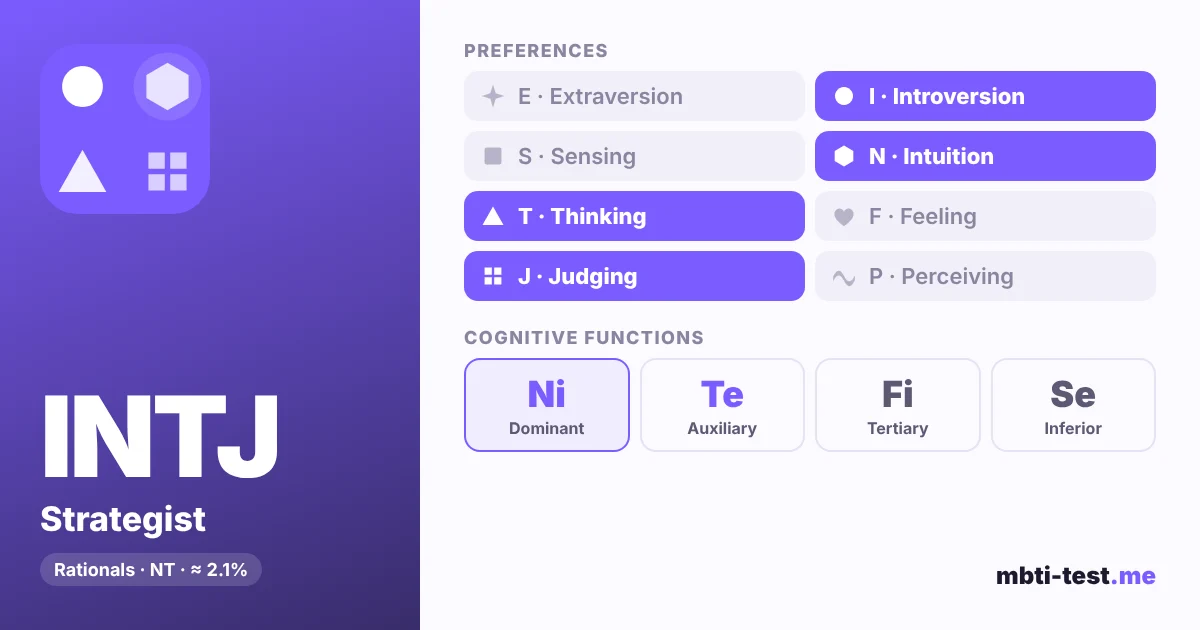
Cognitive functions describe how a type takes in information and makes decisions. The order matters:
- Ni
Introverted Intuition · Dominant
Sees where things are heading. Connects scattered clues into one clear insight or vision of the future. (your core strength)
- Te
Extraverted Thinking · Auxiliary
Organizes the outside world. Sets goals, measures results and makes things efficient. (your supporting skill)
- Fi
Introverted Feeling · Tertiary
Follows an inner compass of personal values. Cares deeply about authenticity. (your developing side)
- Se
Extraverted Sensing · Inferior
Lives in the here and now. Notices sights, sounds and opportunities and reacts fast. (your blind spot under stress)
INTJ in love & relationships
In love, INTJs are selective and serious. They would rather wait for a partner they truly respect than date casually. Once committed, they are loyal and invest real effort in making the relationship work — sometimes even treating it like a project worth improving.
Partners may need to know that an INTJ's affection is often practical: fixing your laptop, planning a perfect trip or giving you an honest opinion. INTJs grow when they learn to say the warm things out loud. They often click with ENFP and ENTP partners, whose energy and openness balance their focus.
INTJ as a friend
INTJs keep a small circle of friends who can handle deep conversations and blunt honesty. They do not need daily contact, but they remember what matters to the people they care about.
INTJ at work
At work, INTJs shine when they have autonomy, complex problems and a clear goal. They dislike micromanagement, office politics and meetings without purpose. Give them a messy system and the freedom to redesign it, and they will deliver work of exceptional quality.
Best careers for INTJ
- Software architect
- Data scientist
- Strategy consultant
- Engineer
- Scientist / researcher
- Investment analyst
- Lawyer
- Product manager
- Surgeon
- University professor
Any career that rewards independent thinking, expertise and long-term planning tends to suit INTJs. Roles with constant small talk or rigid routine may drain them.
INTJ under stress & growth tips
Under heavy stress, INTJs can fall into their inferior function, Extraverted Sensing: they may overindulge in food, screens or impulsive spending, or become unusually irritable about noise and mess. Rest, exercise and time alone usually bring them back.
- Share your reasoning before announcing your conclusion — it helps others follow you.
- Ask "how will this feel for the people involved?" before finalizing a decision.
- Celebrate progress, not only perfect outcomes.
- Try one new sensory hobby, such as cooking or hiking, to balance your busy mind.
Best matches for INTJ
These types often click with the INTJ because they share a way of seeing the world while balancing each other out.



Check INTJ compatibility with any type →
Often confused with: INTP – Theorist
If your result was close, compare the INTJ with the INTP. The two share some letters but use different functions.
Frequently asked questions
What is the difference between INTJ and INTP?
Both are analytical introverts, but INTJs lead with Introverted Intuition and like to decide and plan (J), while INTPs lead with Introverted Thinking and prefer to keep exploring ideas (P). INTJs ask, "Where is this going?" INTPs ask, "How does this work?"
Are INTJs cold?
Not really. INTJs feel deeply but process emotions privately and express care through actions. They can seem distant with strangers and become warm and playful with people they trust.
Who should an INTJ marry?
Any type can make a good partner. INTJs often report strong relationships with ENFPs and ENTPs, and comfortable ones with INFJs, because those types share an intuitive way of seeing the world.
How rare is the INTJ personality type?
Estimates suggest that about 2.1% of people have INTJ preferences, which makes it one of the rarest of the 16 types. Exact numbers vary by country and study.