
Is MBTI accurate?
The honest short answer
MBTI-style tests are good at starting conversations about how people differ. They are less good at precise prediction. Psychologists generally prefer the Big Five model for research, because it measures traits on continuous scales and has stronger evidence for predicting behavior.
That does not make your result useless. Many people find their type description strikingly familiar, and the language of types helps teams, couples and friends understand each other.
Main scientific criticisms
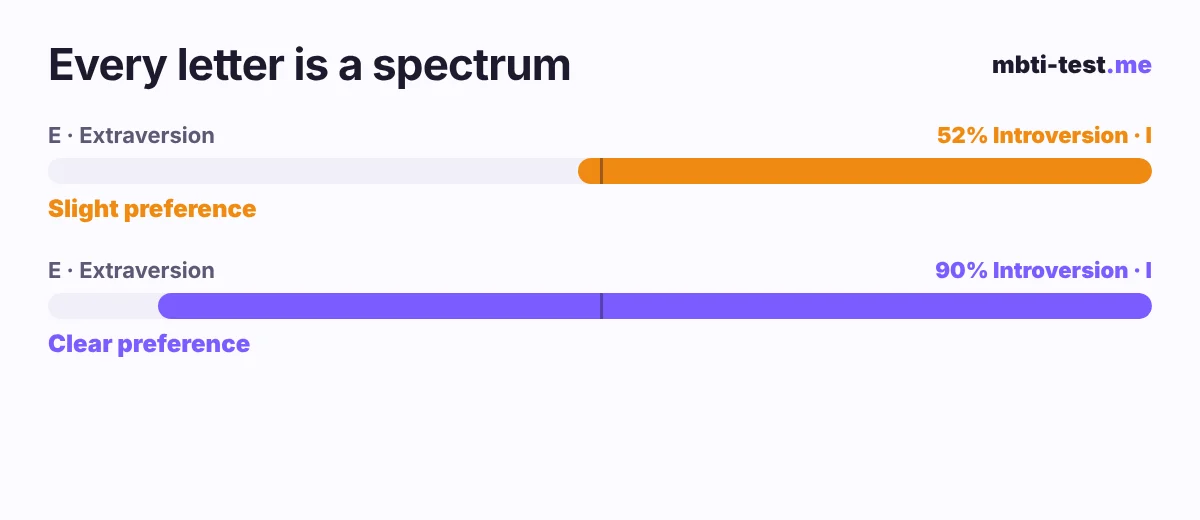
- Types vs spectrums: most people score near the middle on at least one pair, yet the model places them on one side.
- Retest stability: a significant share of people get at least one different letter when they retake a test weeks later, especially if they were close to 50%.
- Missing neuroticism: MBTI does not measure emotional stability, one of the Big Five traits.
- The Barnum effect: positive, general descriptions can feel accurate for almost anyone.
How our test tries to be fair
Our free test uses 48 original statements, 12 for each pair. Half of them are worded toward one side and half toward the other, which reduces the bias of people who simply agree with everything. We show a percentage for every pair and warn you when a result is close to the middle, so you can read both profiles. Your answers are scored in your browser — we never see them.
MBTI vs 16Personalities vs Big Five
Official MBTI® is a paid questionnaire from The Myers-Briggs Company, usually taken with a certified practitioner. 16Personalities uses MBTI-style letters but its own model, closer to the Big Five, and adds an "-A/-T" identity scale. Big Five measures openness, conscientiousness, extraversion, agreeableness and neuroticism on continuous scales. Our test is an independent, free MBTI-style assessment based on the four classic preference pairs.
How to get the most out of your result
- Answer as you usually are, not as you would like to be.
- If a letter was close to 50%, read the profile of the neighboring type too.
- Learn your cognitive functions — they often explain more than the letters.
- Retake the test after a few months, in a calm moment.
- Use type to understand, never to limit yourself or others.
Frequently asked questions
Can my MBTI type change over time?
Core preferences are fairly stable for most adults, but results can change with life stage, stress or simply because a preference was close to the middle.
Is MBTI pseudoscience?
Many psychologists criticize it for its strict type categories and limited predictive power. It is better seen as a self-reflection framework than as a clinical or scientific measurement.
Is 16Personalities the same as MBTI?
No. 16Personalities uses similar four-letter codes but a different model, based partly on the Big Five, plus an extra Assertive/Turbulent scale.