

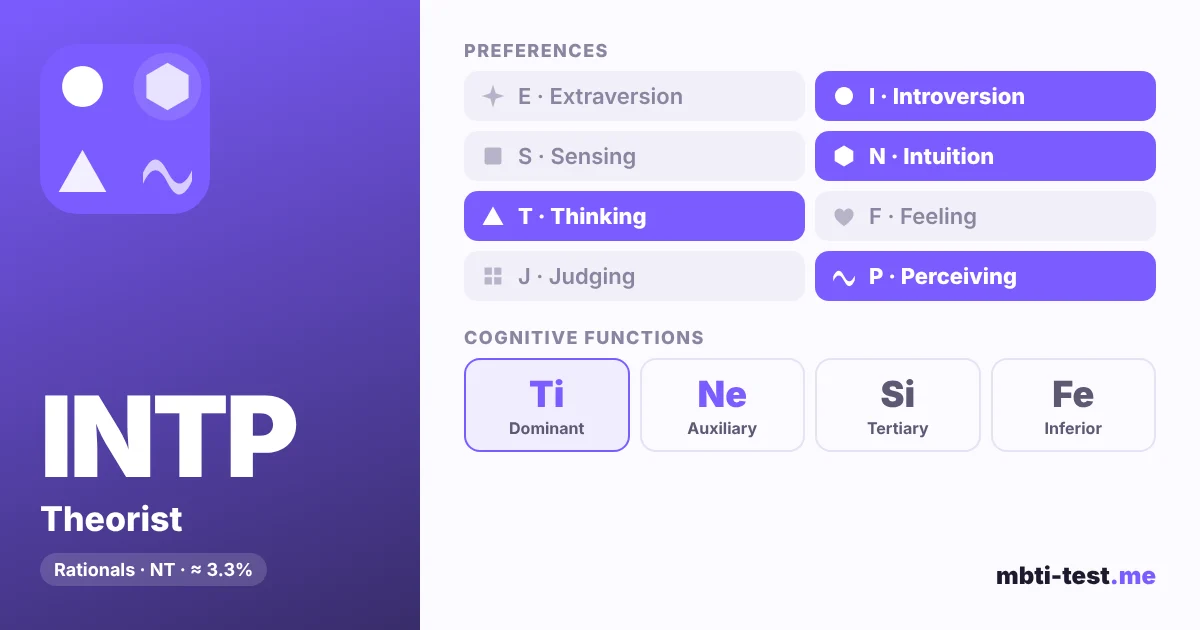
Rationals · NT
INTP: The Theorist
Curious, inventive thinker who loves to understand how everything works.
Who is the INTP?
INTPs are the people who ask "but why?" long after everyone else has stopped. They enjoy puzzles, theories and thought experiments, and they can lose track of time when an idea grabs them. For an INTP, understanding something deeply is its own reward.
They are usually calm, easy-going and open-minded. INTPs rarely judge people for unusual opinions — they would rather explore them. At the same time, they are precise with words and quick to notice when an argument does not add up, which can make them seem critical even when they are just curious.
INTPs often have many projects started and fewer finished. Their challenge is not intelligence or creativity but follow-through: once the interesting part is solved, the routine part can feel like a chore.
Core INTP traits
Endless curiosity
INTPs read, research and question everything. Their interests are wide and often unusual.
Logical precision
They value accurate definitions and consistent reasoning, and notice contradictions instantly.
Open-minded
New perspectives excite rather than threaten them. They change their minds when shown better evidence.
Quiet independence
They need time alone to think and prefer to work at their own pace.
Strengths & Blind spots
Strengths
- Analytical and objective
- Original, inventive ideas
- Open to new information
- Calm under pressure
- Honest and unpretentious
Blind spots
- Procrastinates on routine tasks
- Can get lost in thought
- Struggles to express emotions
- May come across as condescending
- Dislikes rules that seem arbitrary
INTP cognitive function stack
Cognitive functions describe how a type takes in information and makes decisions. The order matters:
- Ti
Introverted Thinking · Dominant
Builds an inner framework of logic. Wants to understand exactly how and why something works. (your core strength)
- Ne
Extraverted Intuition · Auxiliary
Sees what could be. Generates ideas, links and possibilities, and loves brainstorming. (your supporting skill)
- Si
Introverted Sensing · Tertiary
Remembers what has worked. Compares the present with rich personal experience and values routine. (your developing side)
- Fe
Extraverted Feeling · Inferior
Reads the emotional climate of a group and works to create harmony and connection. (your blind spot under stress)
INTP in love & relationships
INTPs often take time to open up, but when they do, they are genuine, loyal and refreshingly free of games. They want a partner who is also a friend and a thinking companion — someone they can talk to about anything at two in the morning.
Emotional conversations can feel uncomfortable for them, so they may show love by sharing interests, solving problems or simply giving their full attention. Partners such as ENTJ and ENFJ often appreciate their depth and help them turn ideas into action.
INTP as a friend
As friends, INTPs are relaxed, funny and non-judgmental. They enjoy a few close friends with whom they can debate, game, joke or sit in comfortable silence.
INTP at work
INTPs do their best work when they can solve complex problems with freedom and flexible schedules. They thrive in research, development and analysis, and struggle with repetitive admin, strict hierarchies or roles that are mostly about selling.
Best careers for INTP
- Software developer
- Physicist / mathematician
- Data analyst
- Philosopher / academic
- Systems engineer
- Game designer
- Economist
- Technical writer
- UX researcher
- Forensic analyst
INTPs flourish in careers where ideas matter more than status, and where they can go deep into a subject without constant interruptions.
INTP under stress & growth tips
When stressed, INTPs can slip into their inferior Extraverted Feeling: they may feel unappreciated, become unusually emotional or worry that everyone dislikes them. Talking to one trusted person and getting back to a favorite project helps them reset.
- Pick one idea and finish it before starting the next.
- Use simple systems (calendar reminders, checklists) for boring tasks.
- Tell people you care — they cannot read your mind.
- Join a group or community around one of your interests.
Best matches for INTP
These types often click with the INTP because they share a way of seeing the world while balancing each other out.



Check INTP compatibility with any type →
Often confused with: INTJ – Strategist
If your result was close, compare the INTP with the INTJ. The two share some letters but use different functions.
Frequently asked questions
Are INTPs smart?
Personality type does not measure intelligence. INTPs simply enjoy abstract thinking and analysis, so they often spend a lot of time learning and may stand out in intellectual subjects.
What is the difference between INTP and ISTP?
Why do INTPs procrastinate?
INTPs are motivated by interest rather than deadlines. Once a problem is solved in their head, the remaining routine steps feel less urgent. Breaking tasks into small, interesting chunks usually helps.
How rare is the INTP personality type?
Estimates suggest that about 3.3% of people have INTP preferences, which makes it a moderately common type. Exact numbers vary by country and study.